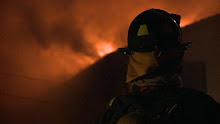
Smoke billows over the city nightly. Our guess is that it's trash burning, and it gives the skyline a war-zone aura. It's trash now...it was buildings. And bodies.
I'm learning that Haiti is a country of dichotomies. Every morning, a marching band raises the Haitian flag on the grounds of the presidential palace as the many people in the nearby tent city watch. Though there is no sewage system or electricity in the tent cities, last night I watched a lone garbage truck making its rounds through the streets.
We transported two patients today. One went to the ED with a rigid abdomen while another patient needed transport to University of Miami for an ortho consult on an ankle fracture. CIMO drives the ambulance for us, and we run emergent everywhere. With the heavy congestion on the roads however, it does little to help.
Working in the clinic, we've gotten a crash course on antibiotics and common infections from our peds ER doc. The patient population we are seeing is about 75% pediatric, so it's a helpful session.
The strength and compassion of the Haitians we work with continues to impress, and in an effort to equal them, TJ and I are going to try and work a 36 hour shift tomorrow, covering the night shift at the emergency department (we hear they are understaffed at night).
On a side note, our tent really stinks. I think we really stink. As hot as it is on the roof, Evans says it's too cold for him to sleep up there. I guess our living arrangements are for the best.
Tuesday, March 30, 2010

Saturday, March 27, 2010
Day 2
Our clinical days are idyllic, compared to how it must have been right after the earthquake. The stream of patients is still unending, but there is much less trauma now. The clinic's surgical room has seen little surgery as of late. The clinic is split into three stations, sometimes four. Station one is for general treatment, housed in one of those pop-up tent shelters in the compound. Station two is primarily wound care, though also general treatment. It is in one of the buildings in the barracks. There is also a pediatric station inside the barracks, and some days there is an OB/GYN room. TJ and I spent most of our time in station one, rotating as needed through the other sites.
It's easy to lose count of how many patients we see. I saw kid after kid after kid--lots of pediatric exposure. Lots of diarrhea, malnutrition, respiratory infections, skin infections....These kiddos just can't stay healthy with the conditions they are living in. A lot of kids are showing signs of stress from the earthquake, sometimes silently crying as they sit. Perhaps the most difficult thing is knowing we are providing temporary solutions to chronic problems. Still, we treat with pedialyte, Ibuprofen, antibiotics, and anything else pertinent from the pharmacy. It is a new challenge, since most of the medications are in Spanish.
Three to four times a day TJ or I catch a nearly comatose child in line, limp in their mother's arms. These go straight to our peds ED doc.
TJ and I transport one patient via the ambulance CIMO has to the OB ward. There aren't any doctors there, and we're not sure we improved her situation. Later that night I helped the ped's doc extract chipped teeth from a three year old who fell.
My translator is Jacklin, a Haitian medical student. He's smart and compassionate--I would love to see him back in school soon, as he is the type of person Haiti needs so much right now. TJ is working with a CIMO guy named Evans. He has the interest and aptitude to be a medic, and we are trying to teach him as we go along. Really, we couldn't have done anything without these two during the week. They translated, helped us wade through situations, and gave us something to shoot for in integrity. Both have been working almost non-stop since the earthquake. Jacklin has worked with different medical teams as a translator. He always pushes for the teams to go further into IDP (internally displaced people) camps to reach those who can not reach us. Evans was in the presidential palace when it collapsed, but his sense of duty has kept him on the job through it all. He and his sisters even adopted an orphaned 15-month old after the earthquake. Evans is so proud of his new son.
The only crack in their armor is their eyes. You can see the sadness, especially when we see patients. There is the woman with her newly adopted son, trying to take care of him though she has no food or shelter to offer. The family of four, a single mother, still without shelter. The twelve year old with no one.
That night was unbearably hot in our tents, pouring sweat inside as the rains pounded outside. A few questions on my mind as I try to sleep: What is the end game in Haiti? Who rebuilds? Where has the government been? How do houses get rebuilt? It is so important to ensure your donation money makes it to the ground here. How does this situation become something other than the status quo?
It's easy to lose count of how many patients we see. I saw kid after kid after kid--lots of pediatric exposure. Lots of diarrhea, malnutrition, respiratory infections, skin infections....These kiddos just can't stay healthy with the conditions they are living in. A lot of kids are showing signs of stress from the earthquake, sometimes silently crying as they sit. Perhaps the most difficult thing is knowing we are providing temporary solutions to chronic problems. Still, we treat with pedialyte, Ibuprofen, antibiotics, and anything else pertinent from the pharmacy. It is a new challenge, since most of the medications are in Spanish.
Three to four times a day TJ or I catch a nearly comatose child in line, limp in their mother's arms. These go straight to our peds ED doc.
TJ and I transport one patient via the ambulance CIMO has to the OB ward. There aren't any doctors there, and we're not sure we improved her situation. Later that night I helped the ped's doc extract chipped teeth from a three year old who fell.
My translator is Jacklin, a Haitian medical student. He's smart and compassionate--I would love to see him back in school soon, as he is the type of person Haiti needs so much right now. TJ is working with a CIMO guy named Evans. He has the interest and aptitude to be a medic, and we are trying to teach him as we go along. Really, we couldn't have done anything without these two during the week. They translated, helped us wade through situations, and gave us something to shoot for in integrity. Both have been working almost non-stop since the earthquake. Jacklin has worked with different medical teams as a translator. He always pushes for the teams to go further into IDP (internally displaced people) camps to reach those who can not reach us. Evans was in the presidential palace when it collapsed, but his sense of duty has kept him on the job through it all. He and his sisters even adopted an orphaned 15-month old after the earthquake. Evans is so proud of his new son.
The only crack in their armor is their eyes. You can see the sadness, especially when we see patients. There is the woman with her newly adopted son, trying to take care of him though she has no food or shelter to offer. The family of four, a single mother, still without shelter. The twelve year old with no one.
That night was unbearably hot in our tents, pouring sweat inside as the rains pounded outside. A few questions on my mind as I try to sleep: What is the end game in Haiti? Who rebuilds? Where has the government been? How do houses get rebuilt? It is so important to ensure your donation money makes it to the ground here. How does this situation become something other than the status quo?
Sunday, March 14, 2010
JFK-MIA-PAP
We stay the night before our departure at the Howard Johnson in Jamaica, just outside JFK. It is one of the more...colorful...hotels I've stayed in. Nonetheless, we know it will be better than the conditions coming up.
I say we, meaning my travel partner and I. Let's call him TJ. He is a close friend and paramedic as well, and has been a long-time mentor of mine. To cop a cliché, he taught me everything I know. I'm glad to have him on the trip.
The team meets in the lobby at 0245. A freezing rain has started outside, as two shuttle vans load us and our luggage. Thirteen team members and forty bags. TJ and I alone have 200 pounds of gear among six bags and two stretchers. Even then we'll end up short on supplies.
Our team consists of a pediatric ER doc, a primary care doc, a few nurses, and TJ and myself. The docs are phenomenal, and we'll learn a lot from them.
.......................................................
Wheels down in Port au Prince at a little bit after noon. My initial impression is that of a functioning country. There is little visible damage at the airport, although roving humvees and the University of Miami field hospital in the distance are reminders to what brings us here.To my surprise, our flight is positively packed with aid workers. We are hustled into a hanger, where chaos ensues as massive amounts of baggage are unloaded.
After some orderly jostling, our bags are collected and we are herded through a cursory customs check. Outside, in the blinding sunlight, Haiti hits me. A gate separates the airport from the road, and crowded there are people looking for work, looking for people off the plane, and looking to hustle. Our driver meets us, and we begin a caravan towards the vans.
At the vans is a lesson in situational awareness. Men looking for work started arguing with the people our agency had already hired. They thronged around our team leader, a timid women with no medical background. As the team milled about, the crowd got larger and larger. People started pushing and shoving, and voices were being raised. This whole time, TJ and I were on edge, circling the crowd and listening to that fuzzy gut feeling. Some internal tipping point was reached, and we plucked our team "leader" from the crowd, shoved half the team into one van and hustled ourselves and the rest into the other. Welcome to Haiti.
As we drove into the heart of Port au Prince, the scale of destructive began to come into perspective. All around us, there are piles of rubble that used to be buildings. Those that are still standing are missing facades, or floors, or leaning dangerously. A burnt out car flashes past my view. Blocks upon blocks of tents zip by, as rhythmically as utility poles. The tents nearer the airport are bigger, and nicer--the result of USAID and the Red Cross. Nearer in the city, tents become scarce and anyone with more than one tarp has a mansion. Every yard of every house we pass has a tent. No one goes inside.
Our destination is a clinic set up inside what is left of the barracks for the Haitian special forces. The tiny compound is divided from the presidential palace by a tent city covering what used to be a lush, green park. Inside the compound, the soldiers have set up their own tent city in the courtyard. Here is were most of them live with their families. I find out that we are to camp out on the roof of the barracks--apparently it is still structurally safe...comparably. The view from the roof is devastatingly awesome. It overlooks the tent city, and the collapsing presidential palace. Destruction can be found down every street, and the view we have from one side was previously obstructed by a four story building housing the legislature. That building collapsed with many inside.
We set up tents on the flat, concrete roof. The space is shared with other groups, from Columbia, Argentina, and the US. I'm told to keep my tent zipped shut, as there are "rats the size of cats" Turns out not to be an exaggeration.
Our team is thrown into the fire immediately, as the clinic is short-staffed. TJ and I take our first patient when we intercept a doctor who is about to send a pre-ecclamptic patient to a nearby hospital. We throw here on one of the stretchers we brought and load her into a surprisingly modern ambulance owned by the special forces unit we are staying with. Inside is an old Ferno pram, the only supplies being a few angios and some old IV bags. Several translators and a police escort are tossed into the ambulance with us, and off we go.
It will become apparent during the week that anytime the ambulance goes out, it goes lights and sirens. To and from our destination. It seems silly at first, but we roll with it and soon realize it is the only way we have any hope of getting anywhere in a reasonable amount of time, considering the insane traffic congestion on the streets.
Thankfully, the patient remains stable, as our biggest challenge is just finding the hospital. It turns out the hospital is little more than some old MASH-style field tents in the area behind the presidential palace. We are directed straight to the OB ward, where we search for someone in charge. The ward is a few cots in a tent, with no staff in sight. With much translation difficulty, we discern there is no bed for our patient, or a doctor, among somnolent babies and fatigued mothers. With the help of some friendly GIs, we are directed to the ED.
The ED is, again, two field tents together with a few cots. An MD and NP, visibly burnt out, accept our patient. We transfer her over to a bloody green mesh cot that is hastily washed off as we arrive.
Leaving the ED, the smell of heat, people, and concrete fills the air. Evening has set in, and somewhere something is burning. Our work is cut out for us.
We return to the compound, as a curfew is set at dark for all aid workers in the city. Tents are pitched, and as sirens wail across the city, we settle in to our first night in Haiti.

I say we, meaning my travel partner and I. Let's call him TJ. He is a close friend and paramedic as well, and has been a long-time mentor of mine. To cop a cliché, he taught me everything I know. I'm glad to have him on the trip.
The team meets in the lobby at 0245. A freezing rain has started outside, as two shuttle vans load us and our luggage. Thirteen team members and forty bags. TJ and I alone have 200 pounds of gear among six bags and two stretchers. Even then we'll end up short on supplies.
Our team consists of a pediatric ER doc, a primary care doc, a few nurses, and TJ and myself. The docs are phenomenal, and we'll learn a lot from them.
.......................................................
Wheels down in Port au Prince at a little bit after noon. My initial impression is that of a functioning country. There is little visible damage at the airport, although roving humvees and the University of Miami field hospital in the distance are reminders to what brings us here.To my surprise, our flight is positively packed with aid workers. We are hustled into a hanger, where chaos ensues as massive amounts of baggage are unloaded.
After some orderly jostling, our bags are collected and we are herded through a cursory customs check. Outside, in the blinding sunlight, Haiti hits me. A gate separates the airport from the road, and crowded there are people looking for work, looking for people off the plane, and looking to hustle. Our driver meets us, and we begin a caravan towards the vans.
At the vans is a lesson in situational awareness. Men looking for work started arguing with the people our agency had already hired. They thronged around our team leader, a timid women with no medical background. As the team milled about, the crowd got larger and larger. People started pushing and shoving, and voices were being raised. This whole time, TJ and I were on edge, circling the crowd and listening to that fuzzy gut feeling. Some internal tipping point was reached, and we plucked our team "leader" from the crowd, shoved half the team into one van and hustled ourselves and the rest into the other. Welcome to Haiti.
As we drove into the heart of Port au Prince, the scale of destructive began to come into perspective. All around us, there are piles of rubble that used to be buildings. Those that are still standing are missing facades, or floors, or leaning dangerously. A burnt out car flashes past my view. Blocks upon blocks of tents zip by, as rhythmically as utility poles. The tents nearer the airport are bigger, and nicer--the result of USAID and the Red Cross. Nearer in the city, tents become scarce and anyone with more than one tarp has a mansion. Every yard of every house we pass has a tent. No one goes inside.
Our destination is a clinic set up inside what is left of the barracks for the Haitian special forces. The tiny compound is divided from the presidential palace by a tent city covering what used to be a lush, green park. Inside the compound, the soldiers have set up their own tent city in the courtyard. Here is were most of them live with their families. I find out that we are to camp out on the roof of the barracks--apparently it is still structurally safe...comparably. The view from the roof is devastatingly awesome. It overlooks the tent city, and the collapsing presidential palace. Destruction can be found down every street, and the view we have from one side was previously obstructed by a four story building housing the legislature. That building collapsed with many inside.
We set up tents on the flat, concrete roof. The space is shared with other groups, from Columbia, Argentina, and the US. I'm told to keep my tent zipped shut, as there are "rats the size of cats" Turns out not to be an exaggeration.
Our team is thrown into the fire immediately, as the clinic is short-staffed. TJ and I take our first patient when we intercept a doctor who is about to send a pre-ecclamptic patient to a nearby hospital. We throw here on one of the stretchers we brought and load her into a surprisingly modern ambulance owned by the special forces unit we are staying with. Inside is an old Ferno pram, the only supplies being a few angios and some old IV bags. Several translators and a police escort are tossed into the ambulance with us, and off we go.
It will become apparent during the week that anytime the ambulance goes out, it goes lights and sirens. To and from our destination. It seems silly at first, but we roll with it and soon realize it is the only way we have any hope of getting anywhere in a reasonable amount of time, considering the insane traffic congestion on the streets.
Thankfully, the patient remains stable, as our biggest challenge is just finding the hospital. It turns out the hospital is little more than some old MASH-style field tents in the area behind the presidential palace. We are directed straight to the OB ward, where we search for someone in charge. The ward is a few cots in a tent, with no staff in sight. With much translation difficulty, we discern there is no bed for our patient, or a doctor, among somnolent babies and fatigued mothers. With the help of some friendly GIs, we are directed to the ED.
The ED is, again, two field tents together with a few cots. An MD and NP, visibly burnt out, accept our patient. We transfer her over to a bloody green mesh cot that is hastily washed off as we arrive.
Leaving the ED, the smell of heat, people, and concrete fills the air. Evening has set in, and somewhere something is burning. Our work is cut out for us.
We return to the compound, as a curfew is set at dark for all aid workers in the city. Tents are pitched, and as sirens wail across the city, we settle in to our first night in Haiti.

Saturday, March 13, 2010
The Return
I'm back, safe and sound from Haiti.
It was an incredible, intense week. Heartwarming moments and heartbreaking moments. Some of it was easier than I expected, while other parts were harder. Ultimately, I know that our team helped a lot of people in Port au Prince. I really couldn't have done this without everyone's generous support--thank you again.
Over the next few days/weeks I will be posting my experiences there, as I had written them on that day. So take a trip back to the recent past with me, and I will share with you my experiences on the ground in Haiti.

It was an incredible, intense week. Heartwarming moments and heartbreaking moments. Some of it was easier than I expected, while other parts were harder. Ultimately, I know that our team helped a lot of people in Port au Prince. I really couldn't have done this without everyone's generous support--thank you again.
Over the next few days/weeks I will be posting my experiences there, as I had written them on that day. So take a trip back to the recent past with me, and I will share with you my experiences on the ground in Haiti.

Subscribe to:
Comments (Atom)